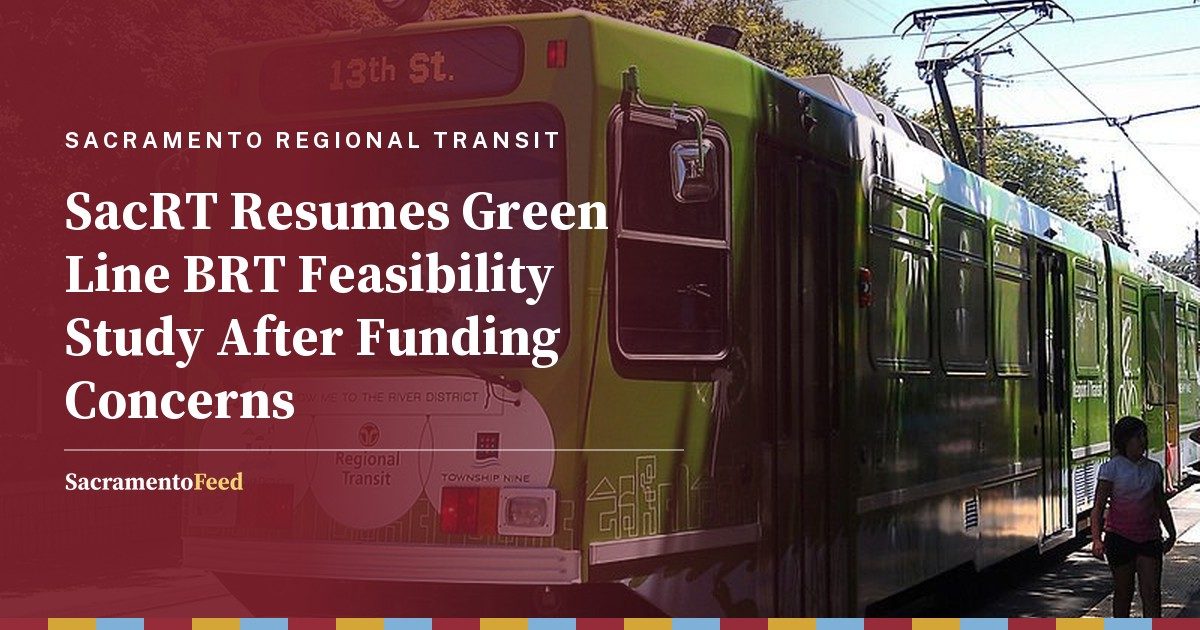
On November 9, 2026, the Sacramento Regional Transit District (SacRT) announced it will move forward with the Green Line Bus Rapid Transit (BRT) feasibility study, which had been paused in October due to funding concerns. The decision follows strong support from stakeholders and the recent declaration by the Associated Press that Proposition 43 was unsuccessful, bolstering confidence in future funding initiatives.
The approximately one-year study is set to begin in early 2027 and will evaluate potential transit connections between Downtown Sacramento, Natomas, and Sacramento International Airport.
Press Release: Sacramento Regional Transit District (SacRT)
Published November 9, 2026. Reproduced in full from the Sacramento Regional Transit District (SacRT).
Green Line to the Airport: A Vision for the Future
UPDATE: SacRT Moves Forward with Green Line BRT Feasibility Study
SacRT paused the Green Line BRT feasibility study in October due to severe concern about shortage of local funding in the future. However, since then, we heard strong support from the Green Line BRT corridor stakeholders and elected officials.
Additionally, the Associated Press declared Proposition 43 unsuccessful. The results strengthened confidence in a future citizen-led funding initiative and the potential to leverage local matching funds. Consequently, SacRT will move forward with the study.
Public response underscores the project’s potential to improve connectivity, expand transportation choices, and support regional growth. The approximately one-year study is expected to begin in early 2027 and will evaluate potential transit connections between Downtown Sacramento, Natomas and Sacramento International Airport.
The study will examine potential routes, service options, infrastructure needs, costs and other considerations to help determine how this important regional connection could move forward.
SacRT appreciates the community’s advocacy and looks forward to continued public engagement throughout the study process.
ABOUT THE PROJECT
The Green Line to the Airport is a long-standing regional vision to connect Downtown Sacramento, North Natomas and Sacramento International Airport with a clean, reliable, high-capacity transit connection.
For more than three decades, regional planning efforts have identified extending light rail to the airport as the ultimate fixed-guideway investment for this corridor. However, with an estimated cost of approximately $2 billion, including a new bridge over the American River and several elevated segments, the full light rail extension will require significant new funding.
To improve mobility in Natomas and the airport corridor sooner, SacRT is pursuing a phased approach that includes evaluating Bus Rapid Transit (BRT) as a potential near-term connection. This approach could provide faster, more frequent transit service while preserving the long-term vision for light rail.
SacRT is moving forward with a one-year Green Line BRT feasibility study, expected to begin in early 2027. The study will evaluate potential routes, service concepts, infrastructure needs, costs and implementation considerations to help determine the best approach for advancing this important regional connection.
Feasibility Study Funding and Next Steps
Working in partnership with the City of Sacramento, County of Sacramento, and the Sacramento Transportation Authority, SacRT has secured $700,000 to study the “Green Line BRT to Sacramento International Airport Project.”
- $500,000 from a Caltrans Strategic Partnerships grant
- $200,000 from a Measure A Smart Growth grant awarded by the STA Board in June
The feasibility study will evaluate BRT as a near‑term connection from downtown to the airport, providing faster transit options for North and South Natomas residents and supporting continued airport expansion.
Study Timeline
The Green Line BRT feasibility study is expected to begin in early 2027 and take approximately one year to complete.
During the study, SacRT will evaluate potential alignments, service concepts, infrastructure requirements, ridership projections, traffic impacts and project costs. Community and stakeholder input will help inform the evaluation and development of recommendations.
Anticipated Schedule:
- Early 2027: Feasibility study begins
- 2027: Technical analysis, development of alternatives and public outreach
- Early 2028: Anticipated completion of feasibility study and recommendations
Additional project phases, including environmental review and design, would follow as appropriate, subject to future decisions, funding and approvals.
Deliverables will include:
- Existing conditions analysis
- Alignment and lane configuration scenarios
- Ridership projections and traffic modeling
- Public outreach and stakeholder engagement
- Cost‑benefit analysis
- Identification of an LPA
Why BRT Now?
SacRT began considering BRT for the airport connection in 2023 as a more affordable, near‑term alternative while the agency continues advancing the long‑term rail vision. A BRT line could be implemented with modest increases in operating funds, whereas a light rail extension requires securing major new revenue sources for construction and operations.
BRT is significantly less expensive than light rail because:
- It uses existing roadway infrastructure
- Stations are smaller and simpler
- Vehicles cost far less
- Construction is faster and more flexible
A two‑car light rail train costs about $10 million, compared to approximately $1.5 million for a 60‑foot BRT vehicle.
Potential BRT Features
Specific design elements for the Green Line BRT have not been finalized. The feasibility study will evaluate features such as:
Dedicated or priority lanes
Enhanced stations
Level boarding
Transit-Signal Priority
Frequent Service
Long Term Light Rail Vision Remains
Evaluating or implementing BRT does not replace or preclude the future Green Line light rail extension. SacRT continues to preserve right‑of‑way, plan station areas, and coordinate with partner agencies so that light rail can be constructed when funding becomes available.
For more than three decades, regional planning efforts including the 1991 System Planning Study, 1993 Transit Master Plan, 2001 Multi‑Corridor Study, 2003 Alternatives Analysis, 2007-2008 Program EIR, and 2010 Transitional Analysis have consistently identified the Green Line light rail extension as the preferred long‑term investment.
The proposed BRT option could serve as an interim step toward delivering improved transit sooner, while ensuring the larger rail vision remains in place.
Green Line Project Map
*This map is subject to change based on the environmental review process.
Click to expand
- City of Sacramento 2035 General Plan, 2015
- American River Crossing Alternatives Study Final Report, 2013
- Metropolitan Transportation Plan / Sustainable Communities Strategy (MTP/SCS), 2012
- Transitional Analysis, 2010
- Green Line Locally Preferred Alternative (LPA) Issue Paper & Board Resolution, 2010
- Final Environmental Impact Report for the Downtown-Natomas-Airport (DNA) Light Rail Transit Phase 1 Project, 2009*
- Final Program Environmental Impact Report (EIR), 2008
- Alternatives Analysis, 2003
*The Green Line to the Airport project used to be called the Downtown-Natomas-Airport (DNA) project.